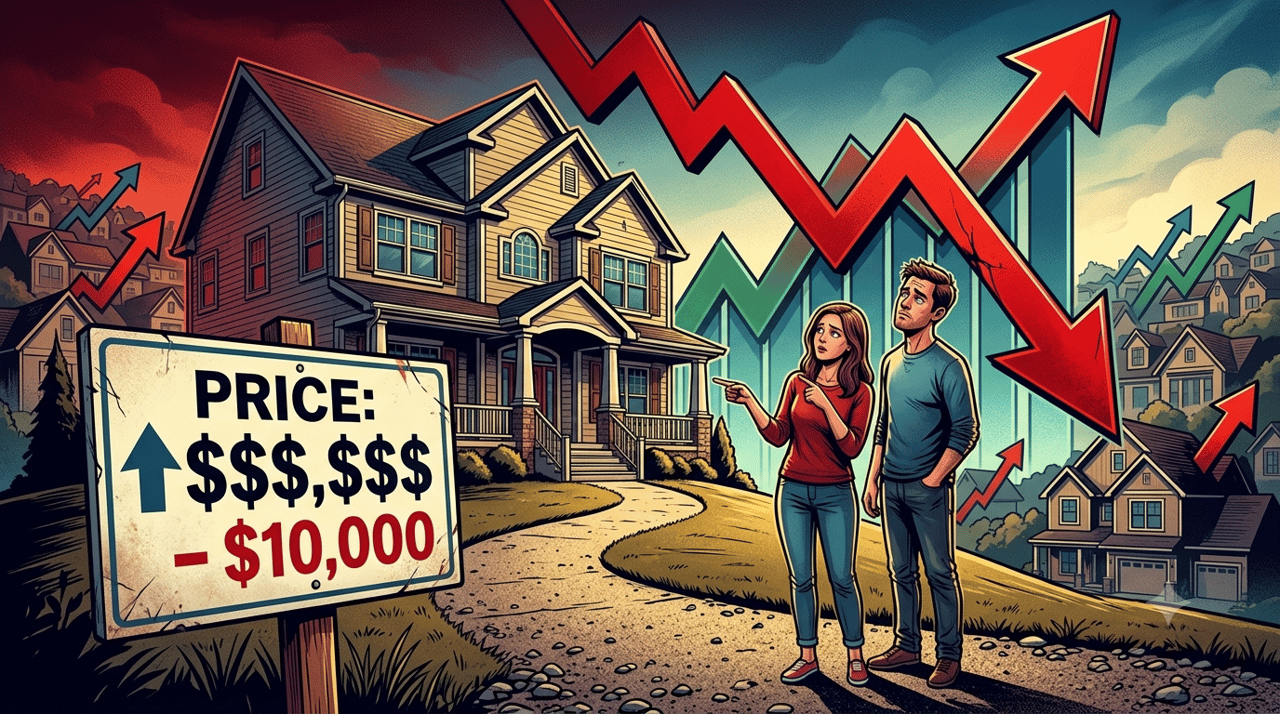
Small Price Drops in Las Vegas Real Estate Are NOT a Market Crash: Here's What the Data Actually Shows
If you've been watching the Las Vegas housing market lately, you've probably noticed something: a few homes that were listed at $410,000 are now showing up at $399,000. Maybe a house in Summerlin that sat for six weeks just dropped $15,000. And you're thinking — is this the beginning of the crash I've been waiting for?
It isn't. And in this post, we're going to show you exactly why — with real numbers, real context, and a clear picture of what's actually happening in the Las Vegas real estate market right now.
The Las Vegas Housing Market in Context: A Five-Year Perspective
To understand why a $10,000 price drop means almost nothing, you have to zoom out. Las Vegas home values have increased dramatically over the past five years. The median home price in the Las Vegas metro area sat around $260,000–$280,000 in 2019. By the peak of 2022, that number had surged past $480,000 in many zip codes.
That's a gain of nearly $200,000 in value in roughly 36 months.
Now ask yourself: in that context, what does a $10,000 price adjustment represent? Mathematically, it's a reduction of about 2.4% from a $410,000 listing price. On a home that has appreciated $180,000 since 2019, it's noise. It's a seller recalibrating to buyer feedback — not a sign that the market is falling apart.
What a Price Reduction Actually Means in Today's Market
There are several very normal reasons a seller might reduce their asking price — none of which spell disaster.
The home was overpriced at listing. This is the most common reason. In a competitive market, sellers list high and hope for the best. When the home doesn't attract offers in the first two to three weeks, they correct course. A $10,000 to $20,000 drop is the seller finding the real market value, not evidence that values are declining.
Buyers have more negotiating power than in 2021. The Las Vegas market in 2020 and 2021 was historic — multiple offers, waived inspections, prices going $30,000 over ask. That frenzy has cooled. Today's buyers can negotiate, ask for closing cost contributions, and request repairs. That's not a crash. That's a healthy, balanced market returning to normal function.
Interest rates have shifted buyer psychology. When mortgage rates moved higher, some buyers became more cautious and sellers responded by being more flexible. But buyer caution and seller flexibility are not the same thing as collapsing property values. Homes are still selling. Equity is still strong. The fundamentals of Las Vegas real estate remain intact.
Las Vegas Real Estate Is NOT in a Crash — Here's the Difference
A true real estate crash — like what Las Vegas experienced from 2007 to 2012 — has very specific characteristics. Home values dropped 50% to 60% during that period. Foreclosures flooded the market. Unemployment in Nevada hit nearly 14%. Construction had completely overbuilt supply. Banks were failing.
None of those conditions exist today.
Current Las Vegas market indicators show unemployment near historic lows, continued population growth driven by California migration, extremely limited housing inventory, and strong demand from both owner-occupants and investors. There is no wave of distressed properties or foreclosures on the horizon.
When commentators point to price reductions as evidence of a crash, they're either misreading the data or cherry-picking individual listings to fit a narrative. The macro picture tells a completely different story.
The Real Cost of Waiting for a Crash That Isn't Coming
Here's the painful truth about market timing in real estate: the people who waited for a crash in 2018 ended up paying dramatically more in 2021. The people who waited in 2020 — certain that the pandemic would tank prices — watched values skyrocket 25% in 12 months while they sat on the sidelines.
Every month you wait, one of three things is happening: you're paying rent that builds no equity, you're watching available inventory tighten as more buyers re-enter the market, or you're facing the risk of a higher interest rate environment down the road.
Waiting for a 30–40% correction in Las Vegas would require a catastrophic economic event that current indicators simply do not support. Waiting for a 5–10% correction means you might save $25,000 on a purchase price while spending $24,000 in rent waiting for it to happen.
What Smart Las Vegas Buyers Are Doing Right Now
The buyers winning in today's market are not the ones waiting for perfect conditions. They're the ones who understand value, negotiate well, and act when the right property becomes available.
Right now, buyers have leverage they haven't had since 2019. Sellers are more willing to negotiate on price, cover closing costs, make repairs, and accept contingencies. The frenzied bidding wars of 2021 are gone. That's actually a buyer-friendly environment — if you're positioned to take advantage of it.
The key is working with an agent who understands the local data, can show you what comparable homes have actually sold for (not just listed at), and can guide you toward properties where the price reduction reflects motivated sellers rather than a problem with the property.
Neighborhoods to Watch in Las Vegas Right Now
Price adjustments, where they exist, are not happening evenly across the market.
Entry-level homes in zip codes like 89110, 89115, and 89031 still see strong demand because first-time buyer and investor interest remains high. Midrange inventory in Henderson, Summerlin, and the Southwest has seen some softening — meaning real opportunity for buyers who were previously priced out of those areas. Luxury inventory above $700,000 has experienced the most meaningful adjustments, as that segment is more sensitive to interest rate changes and broader economic uncertainty.
Understanding which segment fits your goals is exactly the kind of insight a knowledgeable buyer's agent provides.
The Bottom Line
A $10,000 reduction on a $409,000 home in Las Vegas is not a warning sign. It's not a harbinger of collapse. It's a seller making a rational pricing adjustment in a market that has normalized after an unprecedented run-up.
The Las Vegas real estate market is not crashing. It is correcting from historically overheated conditions back toward a sustainable pace — and that is good news for buyers who act with knowledge and intention.
If you're serious about buying in Las Vegas and want to understand what the numbers actually look like for your budget and your timeline, let's talk. Drop a comment, send a message, or give us a call. We'll show you exactly where the value is in today's market.